Canada’s Emergency Alert Patchwork in 2026: Why Your Province’s System Isn’t Enough for Personal Safety
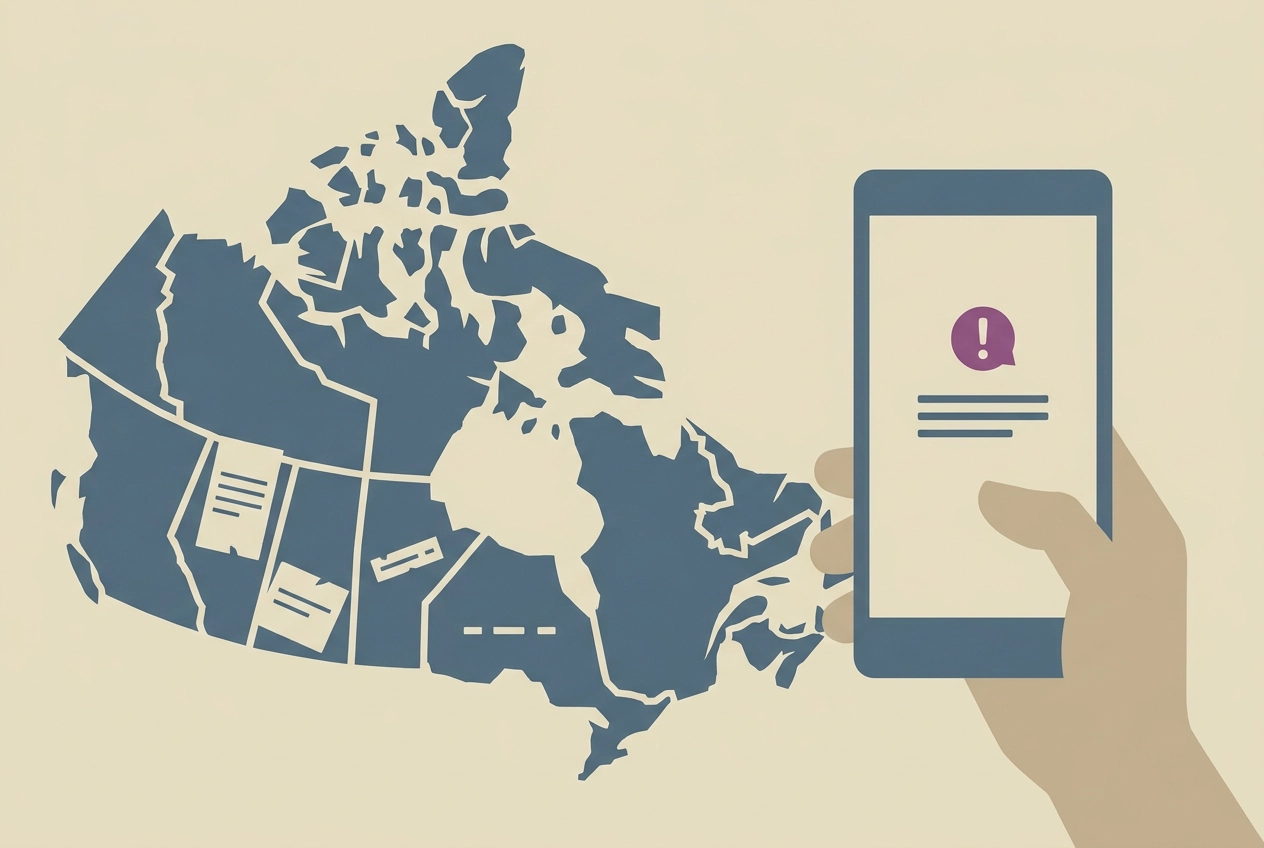
Canada’s emergency alert infrastructure is a fragmented patchwork of federal, provincial, and territorial systems. Some provinces run parallel platforms. Others have coverage gaps tied to geography, network connectivity, or device compatibility. Quebec and Saskatchewan sat out the national test in May 2026 entirely. And even in provinces with strong coverage, broadcast alerts tell you about a threat in a region. They cannot tell your family where you are.
This analysis breaks down exactly how Canada’s Alert Ready system works, walks through the province-by-province variations including BC’s parallel platform and Alberta’s coverage boundaries, and takes a close look at Nova Scotia emergency alert app infrastructure and where it falls short for individuals. Most importantly, it explains why a personal SOS layer with GPS transmission is not a luxury addition to these systems. It is the piece that makes your safety plan complete.
How Canada’s Alert Ready System Actually Works
Alert Ready is not a single government-run system. It is a collaborative network operated jointly by federal and provincial governments, Pelmorex, licensed broadcasters, and wireless carriers. Each partner handles a distinct piece of the delivery chain, which means no single authority controls end-to-end performance.
Alerts reach Canadians through three channels: television, radio, and compatible wireless devices on LTE or 5G networks. Television and radio deliver broadly but require a receiver to be on. Wireless delivery is more direct but depends on the device being LTE-compatible, running current software, and connected to a qualifying network at the moment an alert is issued. If any of those conditions are not met, the alert does not arrive.
Alert Ready tests are conducted twice a year, typically in May and November. That means the system’s real-world delivery can be formally verified as infrequently as once every twelve months. A resident who missed the May test has no guaranteed second chance to confirm their device is configured correctly before the next emergency.
Since 2025, Alert Ready has delivered over 946 emergency alert messages across Canada. That figure conveys genuine scale and activity. It does not, however, tell you how many of those alerts reached every intended recipient. Coverage depends on geography, carrier infrastructure, device age, and user settings in ways that vary significantly across the country.
The most important structural boundary is this: Alert Ready is designed for geographic broadcast, not individual location awareness. When an alert is issued, it targets a defined zone. Every compatible device in that zone may receive it. No one outside that zone will. Understanding why mass alert systems save lives within their design limits helps clarify exactly where those limits end, and where a personal safety layer must begin.
Province by Province: The Emergency Alert Patchwork Explained
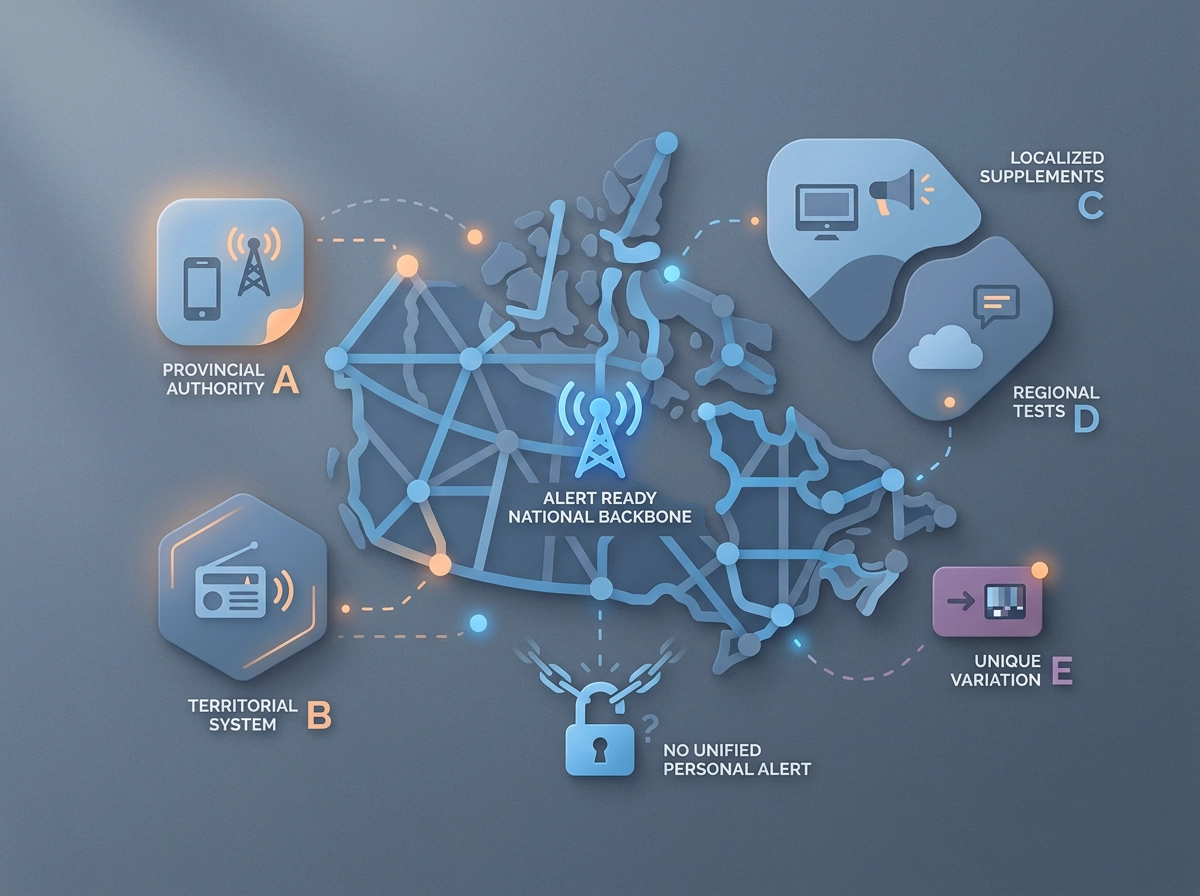
Alert Ready provides the national backbone, but what sits on top of it varies significantly depending on where you live. Provincial and territorial governments retain full authority over how alerts are issued, tested, and supplemented within their borders. Canada has no single unified personal alerting infrastructure, and that is not a temporary gap. It is how the system was built.
The clearest proof came on May 6, 2026, when Alert Ready issued a nationwide test. Quebec scheduled no test. Saskatchewan’s test was cancelled. Alert Ready’s own documentation states plainly: “Participation in the Alert Ready test in Canada is determined by each provincial and territorial emergency management organization.” Provincial opt-out is not an anomaly. It is a structural feature.
British Columbia sits at one end of the spectrum. The province operates its own parallel emergency alert system alongside Alert Ready and conducts tests twice yearly when possible, double the CRTC minimum. BC’s provincial guidance also acknowledges explicitly that third-party apps with emergency information notifications may receive test alerts, a formal recognition that broadcast channels alone are not sufficient.
Alberta issues emergency alerts through Alert Ready but has no parallel provincial broadcast infrastructure equivalent to BC’s. Albertans searching for information after an emergency alert today in Alberta are relying entirely on a national system whose wireless delivery depends on LTE coverage and device compatibility, two variables that fail predictably across Alberta’s vast rural landscape.
Nova Scotia also operates entirely within the national Alert Ready framework, with no standalone provincial system. That dependency raises particular concerns given Nova Scotia’s geography: coastal rural communities, limited cell tower density, and a population that includes many residents on older devices that cannot receive LTE-based wireless alerts at all.
The result is that two Canadians, one in BC and one in Nova Scotia, are covered by materially different alert architectures by design. Neither system, in any province, transmits a specific individual’s GPS location to their family. That boundary is consistent coast to coast.
If you want to understand what a personal safety layer looks like alongside these systems, the option that fills this gap is free to download and ready in minutes.
BC Emergency Alert: A Parallel System With Its Own Limits
BC’s parallel system is the clearest provincial example of what the patchwork actually looks like in practice. The province’s decision to build and maintain its own alert infrastructure alongside Alert Ready is an explicit institutional acknowledgement: for a province managing wildfires, tsunamis, earthquakes, and floods, often simultaneously, the national system alone is not enough.
That judgment has produced a measurably higher testing standard. For residents, that means more frequent confirmation that their device settings, carrier configuration, and network connection will actually deliver an alert when a real event occurs. A resident in, say, Kelowna who participates in both a spring and an autumn test has twice the opportunity to catch a configuration problem before it becomes a life-safety gap.
That recognition is already embedded in provincial guidance. For remote workers and others in isolated locations, understanding why emergency alert systems matter across different occupations reinforces why that ecosystem needs multiple layers.
However, BC’s parallel system does not resolve the most fundamental constraint. Both Alert Ready and BC’s provincial infrastructure are broadcast-only mechanisms. They reach a geographic zone; they do not reach a verified individual within that zone. A hiker in the Okanagan backcountry during a wildfire event, sitting in a cellular dead zone, is outside the reach of both systems simultaneously. No broadcast architecture, however well-funded or frequently tested, can close that gap.
The twice-yearly BC test schedule also leaves windows of up to six months during which a resident has no recent confirmation their setup will receive a live alert. Verification once every six months is better than once a year. It is not continuous coverage.
Alberta Emergency Alert: What the System Covers and Where It Stops
Every emergency alert today in Alberta flows through Alert Ready, the same single-channel broadcast network subject to all its device and network constraints.
When Albertans search “emergency alert today Alberta” after a wildfire or flood event, they are usually not researching policy. They are trying to confirm whether an alert they half-noticed, or never received at all, was real. That uncertainty is itself informative: it reflects a system where delivery is probable for most urban residents but genuinely unreliable for a significant portion of the province.
Alberta’s geography explains why. The province’s vast rural and remote areas include resource extraction corridors where LTE signal is sparse or absent. Alert Ready requires an active LTE or 5G connection to deliver wireless alerts. Where that connection does not exist, the alert does not arrive, regardless of how correctly the system was activated.
The population most exposed to this gap is also the population most exposed to physical hazards. Energy sector workers, agricultural workers, and seasonal labourers routinely operate in precisely the terrain where broadcast delivery is least reliable. A wildfire moving toward a remote work camp, or a flood warning relevant to a rural property, is most dangerous to people who are least likely to receive the wireless alert that was issued for their zone.
The Rural Municipalities of Alberta has formally told the CRTC that many rural areas and highways in the province lack reliable cellular service, and that emergency alerts do not always reach farmers, travellers, Indigenous communities, and people living remote from urban centres.
For Alberta families, the meaningful question is not whether the provincial alert system exists. It is whether, at the moment it matters, the alert reaches the specific person at the specific location. For those operating outside reliable LTE coverage, the honest answer is: not reliably.
Nova Scotia’s Emergency Alert Coverage: Geography Makes It Personal
Alberta’s alert vulnerabilities trace directly to geography and infrastructure. Nova Scotia compounds both with an added factor: the province has no parallel system at all.
That dependency raises particular concerns given Nova Scotia’s geography. Every wireless alert Nova Scotians receive depends on LTE or 5G availability, a compatible device, and correct device settings. Alert Ready’s own documentation confirms that device compatibility, network connectivity, and configuration issues mean not all Canadians will receive any given alert. In Nova Scotia, those dependencies land on difficult terrain.
The province is a peninsula edged by rural coastal communities, many of them underserved by cell tower infrastructure. The Municipality of Cumberland’s mayor has described rural cell coverage as “spotty, to say the least.” Residents in those areas have reported missing alerts during hurricanes and floods in recent years. Older residents on 3G devices or Wi-Fi-only connections receive nothing from a wireless broadcast that requires LTE. The provincial government recognised this explicitly when it launched NS Alert in August 2025, specifically to reach people that Alert Ready cannot. The first gap NS Alert was built to close: it works on 3G and Wi-Fi, because Alert Ready does not.
Searches for a nova scotia emergency alert app are not curiosity. They reflect residents who have already experienced uncertain coverage and are actively looking for something more reliable. That population need is real and documented.
But even NS Alert, like Alert Ready, is a broadcast tool. It can tell a defined region that danger exists. It cannot confirm that a specific person received the message, acted on it, or reached safety. It transmits no GPS coordinates to anyone. If your family wants to know whether you have left a flood zone or are still inside it, no provincial or national broadcast system in Canada answers that question.
That is not a design failure. Broadcast systems move information from government to population. The reverse direction, from an individual to the specific people who will come for them, is what a personal SOS layer is built to provide.
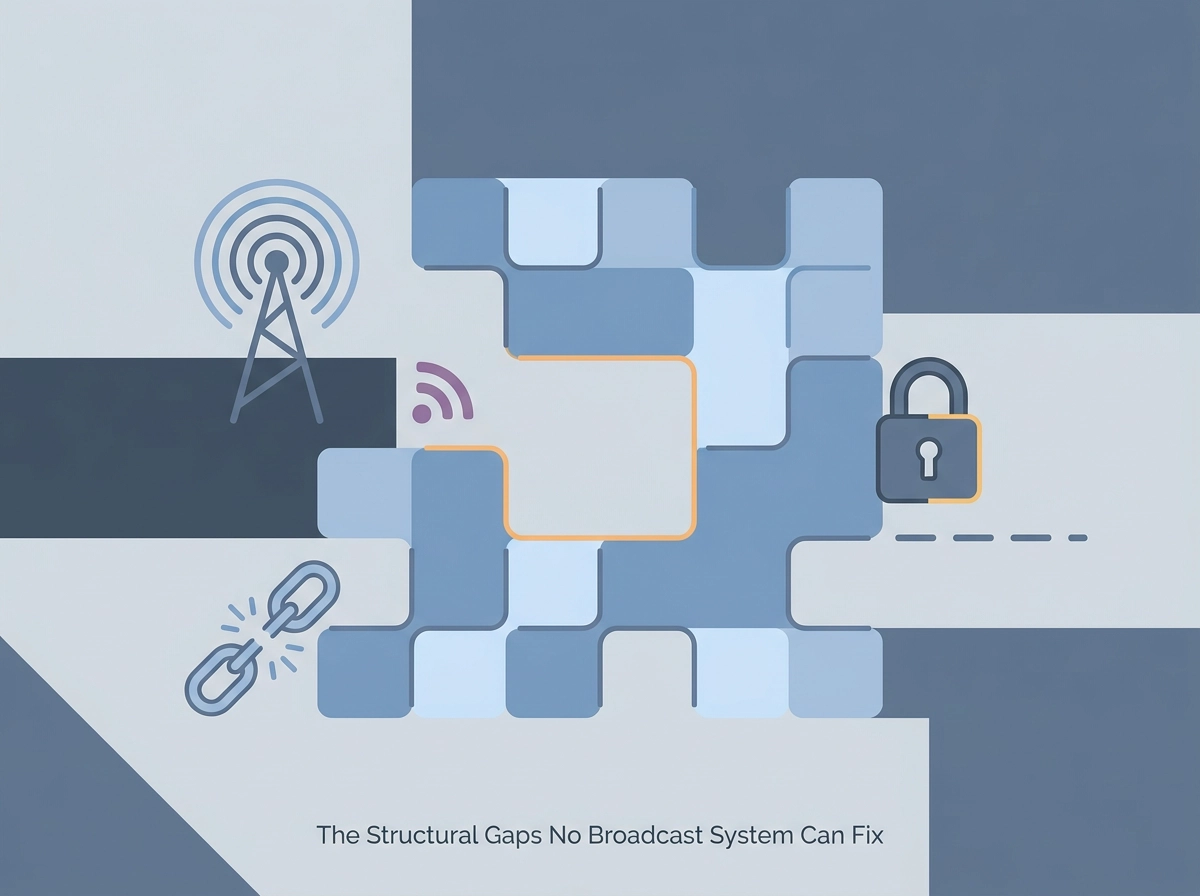
The Structural Gaps No Broadcast System Can Fix
Nova Scotia’s coverage limits are not an isolated provincial quirk. They reflect something more fundamental: every broadcast emergency alert system in Canada, regardless of province, shares the same structural ceiling.
The network requirement is absolute. Alert Ready’s wireless delivery requires an active LTE or 5G connection at the exact moment an alert is issued. Where that connection does not exist, no alert arrives. Coverage gaps are not outages waiting on a technician. They are permanent features of Canadian terrain: remote coastlines, mountain corridors, northern communities, and agricultural stretches where cell infrastructure has never been economically viable to build. Every province has them.
Device compatibility is a documented, unresolved limitation. Older smartphones and feature phones do not receive wireless emergency alerts, regardless of carrier or signal strength. Alert Ready’s own guidelines require a WPA-compatible device running current operating software. The CRTC mandates network-level participation from wireless carriers. Compatible device ownership remains the individual user’s responsibility. Millions of Canadians using older hardware are excluded from wireless alerting, and no regulation requires them to be told so directly.
Silent disablement is a risk most Canadians have never actively verified. Device settings, software updates, and configuration changes can affect alert reception. Alert Ready’s own guidance notes that device settings and software configuration are among the factors that determine whether an alert arrives, a dependency most users have never actively verified. A Canadian who last checked their settings two years ago, or never, may believe they are covered. The only moment they discover otherwise is during an actual emergency. The test schedule exists partly to surface this problem, but gaps between tests leave extended windows of unverified exposure.
Zone-based targeting is a design choice, not a flaw to be corrected. A person who drove into a wildfire corridor after an alert was issued to that zone may receive nothing. A person who evacuated before the alert was issued may still receive it. The system moves hazard information toward a population; it was never designed to track individuals.
That last point is the most important structural boundary of all. The information flow is one direction only: government to population. This is not a gap that better funding will close, because it is not a gap. It is the architecture. Broadcast systems in every country that uses them share this same boundary. Multi-channel by default, so the alert always gets through is the design principle of a personal SOS tool, not a broadcast network, because broadcast was never built for the reverse direction.
Why Post-Incident Alert Reviews Rarely Reach the Public
Those structural boundaries are largely invisible to the public, and that invisibility is not accidental.
After major Canadian emergencies in which alerting timeliness was publicly questioned, including the 2020 Nova Scotia mass casualty event and the 2021 BC flooding, formal government post-mortems rarely produced publicly accessible breakdowns of which populations did not receive alerts and why. What exists tends to be buried in regulatory filings or technical appendices, not plain-language public reports. Ongoing CRTC consultations into improving the national alerting system are themselves an acknowledgement that current performance is insufficient. But the evidence submitted to those processes is not the same as a public accounting of what went wrong and for whom.
The absence of comparative response-time data is a concrete problem. Canadians cannot easily determine how many minutes typically pass between an emergency designation and a wireless alert arriving on devices in the affected area. That interval matters. Without it, there is no basis for evaluating whether the system performed adequately in any specific event.
Device compatibility rates present the same problem. Government-facing materials describe Alert Ready’s reach in broad, near-universal terms. Exclusions based on device age, LTE availability, or user settings appear, if at all, in technical footnotes. For Canadians in rural areas or older households, this means the system’s actual reach in their specific situation is genuinely unknown to them. Why accessible emergency features matter is a question that broadcast system transparency currently does not help most Canadians answer for themselves.
This accountability gap has a practical consequence. When official materials signal that the system works, individual Canadians have limited basis to assess their own exposure. The official message discourages the kind of independent evaluation that would prompt someone to ask: does my device support wireless alerts, does my location have LTE coverage, and would anyone in my family know where I am if I did not receive a warning?
Those are questions no government report currently answers for you. You have to answer them yourself.
Who Falls Through the Gaps: Hospitality Workers, Caregivers, and Isolated Families
The accountability gaps documented in government materials translate directly into real risk for specific groups of Canadians. Understanding who those groups are makes the structural problem concrete.
Hospitality and lone workers carry a compounding exposure. A housekeeper working an overnight shift on an upper floor of a hotel operates in a building where cell signal may be unreliable, without colleagues nearby, and with no one tracking whether she received an alert or is safe. A broadcast alert reaching her geographic zone confirms a hazard exists. It confirms nothing about her. For anyone with questions people ask about lone worker safety, this gap is precisely the one that matters most.
Caregivers face an information asymmetry that broadcast systems cannot resolve by design. When a caregiver’s phone receives a zone-level alert, it says nothing about whether the person in their care, who may be unable to self-report, is in the same zone, has been transported elsewhere, or received any notification at all. The alert informs the caregiver that danger exists somewhere. It does not tell them where their person is.
Distributed families encounter a version of this problem at larger scale. Knowing an alert has been issued for a region is not the same as knowing whether a specific family member working a remote corridor or living in a different province is inside that zone, has already left it, or sits in a coverage gap entirely.
Older Canadians on legacy devices face a compounding vulnerability. LTE-based wireless alerts require compatible hardware. Devices that predate the compatibility mandate do not receive them, regardless of carrier or signal strength. Older adults are both disproportionately likely to hold those devices and disproportionately likely to need reliable personal safety tools.
Remote resource and agricultural workers in Alberta and BC represent the furthest edge of broadcast reach. Workers operating beyond reliable LTE range receive nothing, and for them a missed alert carries the most serious potential consequences.
What a Personal SOS Layer Actually Does That Broadcast Cannot
Each gap identified in the previous section points to the same structural absence: no broadcast system transmits from an individual to the people responsible for that individual. A personal SOS app addresses precisely that.
The direction of information is different by design. It sends your specific coordinates to the specific people in your designated safety circle. Your family does not receive an alert about a region; they receive your location.
One tap is the critical design constraint. During a medical event, a vehicle incident on a remote highway, or a threat encounter, the cognitive and physical capacity to navigate an interface collapses. One-tap SOS functionality means an alert can be initiated without unlocking a screen, composing a message, or calling a number. That speed is not a convenience feature; it is the feature.
Live location sharing and check-in pings operate continuously, not episodically. Alert Ready delivers a point-in-time broadcast when a designated authority issues a warning. Check-in features and live location sharing let families and caregivers maintain ongoing situational awareness regardless of whether any emergency has been formally declared. That is categorically different from what any provincial alert system, including the BC emergency alert or Nova Scotia’s Alert Ready-dependent infrastructure, can provide.
Notification routing determines who actually responds. ProtectSmartly’s family circle model sends SOS alerts to the people who will act: family members, caregivers, trusted colleagues. During a large-scale emergency, 911 dispatch centres manage hundreds of simultaneous calls. An alert routed to someone who knows you and knows your context produces faster, more targeted action.
For hospitality and lone workers, the panic button addresses a question broadcast systems never ask. A zone-wide alert cannot confirm whether the housekeeper on the fourteenth floor at 2 a.m. is safe. A panic button that transmits GPS coordinates to a supervisor or safety contact answers that specific question, in real time, for that specific person.
The personal SOS layer is not a criticism of Alert Ready or any provincial system. It is the layer those systems were never designed to provide, transmitting in the direction they structurally cannot: from individual to circle, with verified GPS precision.
Building Your Personal Safety Layer Alongside Provincial Systems
Knowing that broadcast and personal SOS tools serve different functions is the first step. Acting on that knowledge is the second.
Broadcast systems at every level — national and provincial — were designed to warn populations, not confirm individual safety. That distinction is not a flaw; it is the design.
What every Canadian should do right now:
- Confirm your device is LTE-compatible and certified by a Canadian wireless carrier
- Keep your phone’s software current; outdated software silently breaks alert reception
- Check your alert settings and run a self-test where your province offers one
- Note your provincial test calendar: at minimum, the annual CRTC-mandated national test; twice yearly if you are in BC
Those steps close the broadcast gap as much as it can be closed on your end.
They do not create a personal safety layer.
For families, caregivers, remote workers, and hospitality staff, the remaining gap is structural and permanent. No provincial or national alert system will ever transmit your GPS coordinates to the people who will come for you. That direction of communication, from individual to family circle, with location precision, requires a personal tool.
Protect Smartly is free to start and built for exactly this complement. One-tap SOS, live location sharing, and family circle notifications fill the space that Alert Ready, BC Emergency Alert, Alberta’s broadcast infrastructure, and Nova Scotia’s geography-constrained coverage were never designed to fill.
The emergency alert system works. The question has never been whether the system functions within its design boundaries. The question is whether those boundaries cover you, in your location, with your people. For that, a personal layer is not a luxury. It is the only answer.
Conclusion
Canada’s emergency alert infrastructure is real, tested, and genuinely useful. But it was built to broadcast outward to populations, not inward to individuals. Every province carries structural gaps: geography, device compatibility, signal dead zones, and the simple reality that no broadcast system knows where you are or who is waiting for you.
The takeaways are clear. Alert Ready and its provincial counterparts cover the macro threat. Personal safety tools cover the micro reality. Neither replaces the other, and neither is optional if you are serious about preparedness.
Your next step is straightforward: complete the device checklist above, then add one personal layer. Download Protect Smartly, set up your family circle, and test it today. The broadcast system will handle the next wildfire warning. Only you can handle the message that says exactly where you are when it matters most.